Extreme weather includes weather events of heightened magnitude or unusually long durations, including high and low temperatures, storms, tornadoes, heavy precipitation, and drought conditions. Episodes of extreme weather can lead to harmful and long-term effects on communities. While extreme weather can impact an entire community, some populations like older adults and people experiencing homelessness may be disproportionately impacted by negative health impacts. CEER maintains a commitment to working with local, state, and federal partners to improve community readiness for extreme weather.
Atmospheric River & Flood Messaging
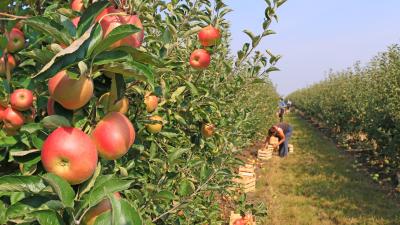
CEER is conducting a content analysis of risk communication messaging shared by local and state agencies, including public health and emergency management, as well as news sources during the December 2025 atmospheric river and flood event that impacted much of Western Washington. This project seeks to understand the communication channels that were utilized, the protective actions recommended to impacted populations, and the trusted messengers used to disseminate those messages.
Extreme Heat Preparedness and Response Implementation
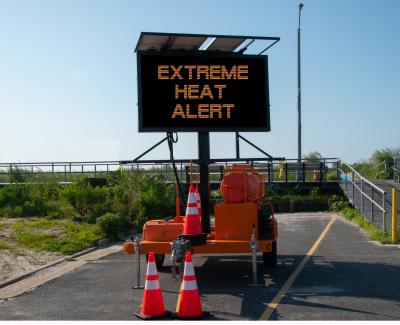
In 2023, CEER investigators conducted focus groups discussions and workshop focused on factors influencing extreme heat event (EHE) preparedness and response implementation with representatives from local health jurisdictions, in partnership with the National Association of County and City Health Officials (NACCHO), Boston University, and the UW Center for Health and the Global Environment. Using an implementation science framework, the study identified factors like partnerships and connections, available resources, and local conditions as influences on local health jurisdictions’ implementation of EHE preparedness and response.
Related resources
Summer in the Cities
In Summer 2023, a CEER team captured extreme heat or heat risk communication from the city and county websites and social media accounts of four large urban regions in the Northwest. The project team has analyzed the content of these communications and developed a manuscript that highlights regional differences in online extreme heat risk communication.
Spokane Extreme Heat Symposium
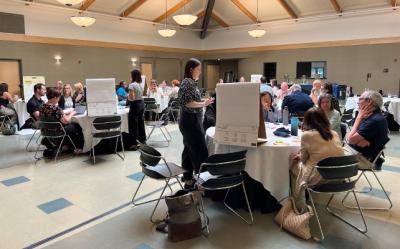
In June 2023, CEER, in partnership with the Gonzaga University Climate Institute, co-hosted the Spokane Extreme Heat Symposium. The symposium brought together Inland Northwest regional partners to engage in dialogue around the 2021 Northwest Heat Dome, identify successful extreme heat risk reduction interventions used in the region, and characterize remaining practice-relevant research priorities.
Findings from the symposium were used to inform Spokane’s first Extreme Heat Resilience Plan, published in 2025.
Related resources
Reed A, Henning BG, Cortes Espinosa M, McKinley H, Busch Isaksen T. Building community resilience to extreme heat: lessons learned from Spokane, WA community conversations. Environmental Research: Health. 2024;2(4):045007. doi:10.1088/2752-5309/ad7975.
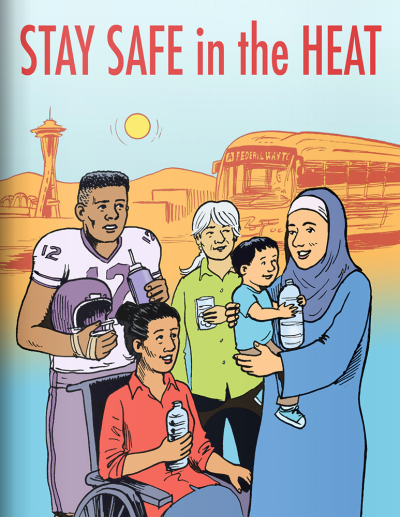
Public Health – Seattle & King County Stay Safe in the Heat Comic
Extreme heat can be unhealthy for everyone, but some groups are at greater risk of illness or death when temperatures rise. CEER researcher Tania Busch Isaksen’s research on heat illness in King County identified specific groups at increased risk of heat-related illness, including older adults, children, people living with chronic illness, and outdoor workers. Public Health Seattle & King County partner Robin Pfohman and Meredith Li-Vollmer conducted focus groups and interviews with target populations to understand community members’ information needs and preferred coping mechanisms for extreme heat. The findings from both research projects informed the design of a comic drawn by artist David Lasky which featured many of Seattle’s diverse communities and the coping mechanisms they use to stay cool in hot weather. The comic was designed to clearly communicate heat safety messages, to represent King County’s diversity of communities, and to be approachable and engaging.
Related resources
Additional Publications
- Scott KK, Errett NA. Content, accessibility and dissemination of disaster information via social media during the 2016 Louisiana floods. J Public Health Manag Pract. 2018;24(4):370-379. doi: 10.1097/PHH.0000000000000708