Urban and rural communities across the western United States are facing new public health challenges as wildfires increase in frequency and severity. Associated smoke hazards that contribute to bad air quality particularly raise concerns for community health, as prolonged exposure can lead to negative health outcomes. CEER works to support research identifying health impacts associated with exposure and wildfire intervention strategies.
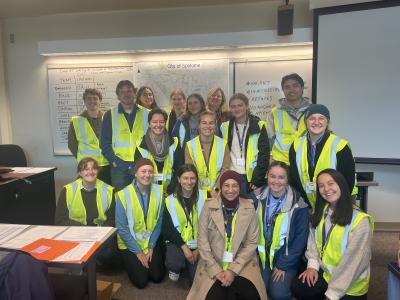
Spokane Community Assessment for Public Health Emergency Response (CASPER)
In October 2025, CEER collaborated with the Gonzaga Institute for Climate, Water, and the Environment to conduct a Community Assessment for Public Health Emergency Response (CASPER) in the City of Spokane to assess household perceptions of wildfire smoke and preparedness needs. CASPER is a rapid needs assessment methodology developed by the CDC that can be deployed following a disaster, however it is useful at other stages of the disaster response cycle to systematically collect and analyze information that is generalizable to the entire community.
The results will be used to inform community climate resilience preparedness efforts, including a citywide smoke plan and a network of community resilience hubs.
JUst Solutions To Impacts of Climate Exposures for Health in Alaska
From 2023 through 2025, CEER collaborated with partners from the University of Alaska Anchorage, the University of Alaska Fairbanks, Alaska Native communities, and Alaska government agencies on the JUSTICE-HIA Project (JUst Solutions To Impacts of Climate Exposures for Health in Alaska), an EPA-funded project that sought to reduce negative health impacts from exposure to climate-sensitive hazards in Alaska communities by improving access to locally relevant climate and social data to support adaptation planning.
As a part of this effort, CEER researchers conducted an implementation science evaluation of low-cost air quality sensor networks that aim to provide access to real-time locally relevant air quality data for rural and Alaska Native communities.
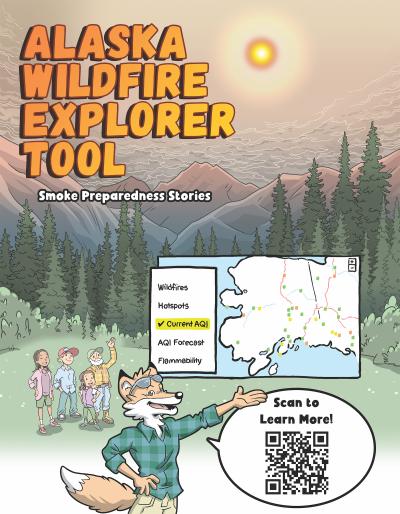
Additionally, CEER researchers guided the co-development of a user guide for Alaska Wildfire Explorer, a web-based wildfire and smoke data tool. The resulting comic book showcases stories of how Alaskans can use wildfire and smoke information during culturally-relevant summer activities like fishing, berrypicking, and attending culture camp to make decisions to keep themselves and their communities safe from poor air quality. The CEER team leveraged an iterative co-creation process grounded in storytelling to develop the five risk communication stories featured in the comic book in collaboration with the entire JUSTICE-HIA project team.
Links to related resources
Alaska Wildfire Explorer: https://alaskawildfires.org/
User guide: https://heyzine.com/flip-book/5663cca9ae.html
Smoke Ready Spokane Symposium
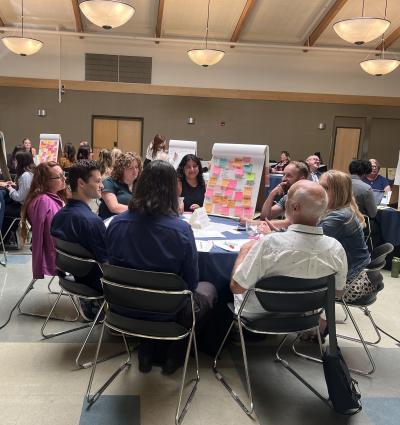
In July 2024, CEER collaborated with the Gonzaga Institute for Climate, Water, and the Environment to host the Smoke Ready Spokane Symposium. The event convened community partners across sectors to reflect on past wildfire smoke events and discuss locally-relevant wildfire smoke exposure reduction strategies. Symposium participants engaged in small group discussions using the World Café Method and identified barriers and facilitators to community wildfire smoke resilience in the Spokane region. Findings from the symposium informed Spokane’s first citywide Wildfire Smoke Resilience Plan.
Link to related resources
Portable Air Cleaner Implementation Assessment
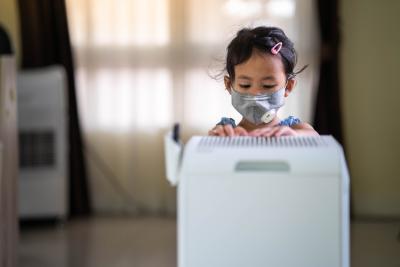
Public health officials are increasingly recommending portable air cleaners as an intervention to reduce wildfire smoke exposure. While portable air cleaners have been shown to reduce indoor air pollution from wildfire smoke, research on their implementation in real-world settings is limited. CEER investigators have partnered with community-based organizations, Tribes, and local health jurisdictions in central and eastern Washington communities that experience high annual wildfire smoke exposure to study how community members use portable air cleaners in their homes, as well as factors that impact their use.
Additional Publications
- Doubleday, A., Choe, Y., Busch Isaksen, T. M., & Errett, N. A. (2021). Urban bike and pedestrian activity impacts from wildfire smoke events in Seattle, WA. Journal of Transport & Health, 21, 101033. https://doi.org/10.1016/j.jth.2021.101033
- Durkin A, Gonzalez R, Busch Isaksen T, Walker E, Errett NA. Establishing a Community Air Monitoring Network in a Wildfire Smoke Prone Rural Community: Motivations, Experiences, Challenges, and Ideas of Clean Air Methow’s Clean Air Ambassadors. Int. J. Environ. Res. Public Health 2020, 17(22), 8393; https://doi.org/10.3390/ijerph17228393
- VanDeventer D, Marcaux J, Doubleday A, Errett NA, Busch Isaksen TM. Wildfire Smoke Risk Communication Efficacy: A Content Analysis to Summarize Washington State’s 2018 Statewide Smoke Event Public Health Messaging. J Public Health Manag Pract. 2020 Apr 17. doi: 10.1097/PHH.0000000000001151.
- Errett NA, Roop HA, Pendergrast C, Kramer B, Doubleday A, Tran KA, Busch Isaksen T. Building a Practice-based Research Agenda for Wildfire Smoke and Health: A Report of the 2018 Washington Wildfire Smoke Stakeholder Synthesis Symposium. Int. J. Environ. Res. Public Health. 2019, 16(13), 2398; https://doi.org/10.3390/ijerph16132398
- Pendergrast C, Errett NA, Roop HA, Doubleday A*, Kramer B*, Anh Tran K**, and Busch Isaksen T. University of Washington Wildfire Smoke Risk Communication Stakeholder Synthesis Symposium World Café Discussion Summary Report. 2019. A report prepared by the University of Washington Department of Environmental and Occupational Health Sciences and the University of Washington Climate Impacts Group, Seattle, WA.